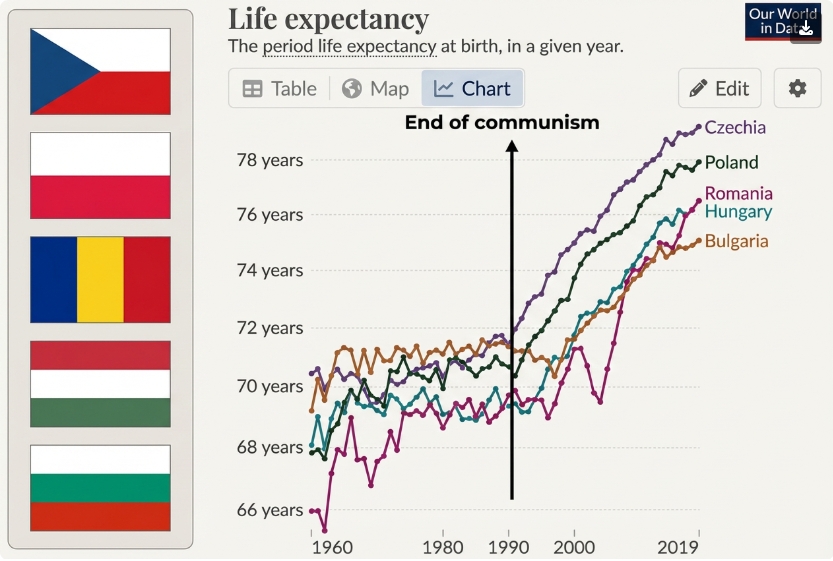
The Democratic Party takeover by extreme leftists does not bode well for the health of the nation’s citizens. History offers a stark warning in the post-communist transformation of Central and Eastern Europe. The chart (h/t X.com @EndWokeness) from Our World in Data illustrates life expectancy trends in Czechia, Poland, Hungary, Romania, and Bulgaria: decades of stagnation from the 1960s through the late 1980s under Soviet-style communism, followed by a sharp, sustained rise after the 1989–1991 collapse of the Iron Curtain. The switch to democratic governance and free-market economies was the decisive cause.
Under communist rule, central planning strangled progress. Governments dictated production quotas, suppressed private property, and allocated resources through political favoritism rather than consumer demand. Healthcare systems, though nominally universal, suffered chronic shortages of modern drugs, equipment, and trained personnel. Innovation stalled because there were no profit incentives for pharmaceutical companies or medical researchers. Diets remained poor—high in carbohydrates, low in fresh produce—while alcoholism and smoking rates soared as coping mechanisms in a gray, oppressive, censorship-driven society.
As a result, life expectancy in these nations flatlined even as Western democracies, with liberal freedoms and free-market economies advancing by five to seven years during the same period.
The 1989 revolutions within these 5 nations swiftly dismantled the command economies that were in place for decades overnight. Instead, they chose democratic constitutions enshrined with individual rights, free speech, and electoral accountability. Market reforms—privatization, price liberalization, and foreign direct investment—unleashed entrepreneurship. GDP per capita in these Central European countries roughly doubled within fifteen years; even slower-reforming Romania and Bulgaria eventually joined the European Union and adopted its regulatory and funding standards.
New wealth funded hospital modernization, imported medicines, and preventive care programs. Supermarkets filled with diverse foods improved nutrition. Competition among insurers and providers raised the quality of care. Personal freedoms also mattered: citizens could pursue healthier lifestyles without state-mandated conformity or surveillance.
By 2019, the five nations had added between four and eight years of life expectancy, erasing the communist-era gap with Western Europe. The chart’s inflection point at “End of communism” is no coincidence. It proves that removing central control, protecting property rights, and letting markets allocate resources delivers measurable gains in human welfare.
The lesson is universal: policies that concentrate power in the state at the expense of individual liberty and economic freedom predictably harm public health. Nations that forget this history of inefficient and corrupt command economies will dramatically increase the risk of significant degraded health outcomes for its populace.

 NewsOpinions
Leave a comment